


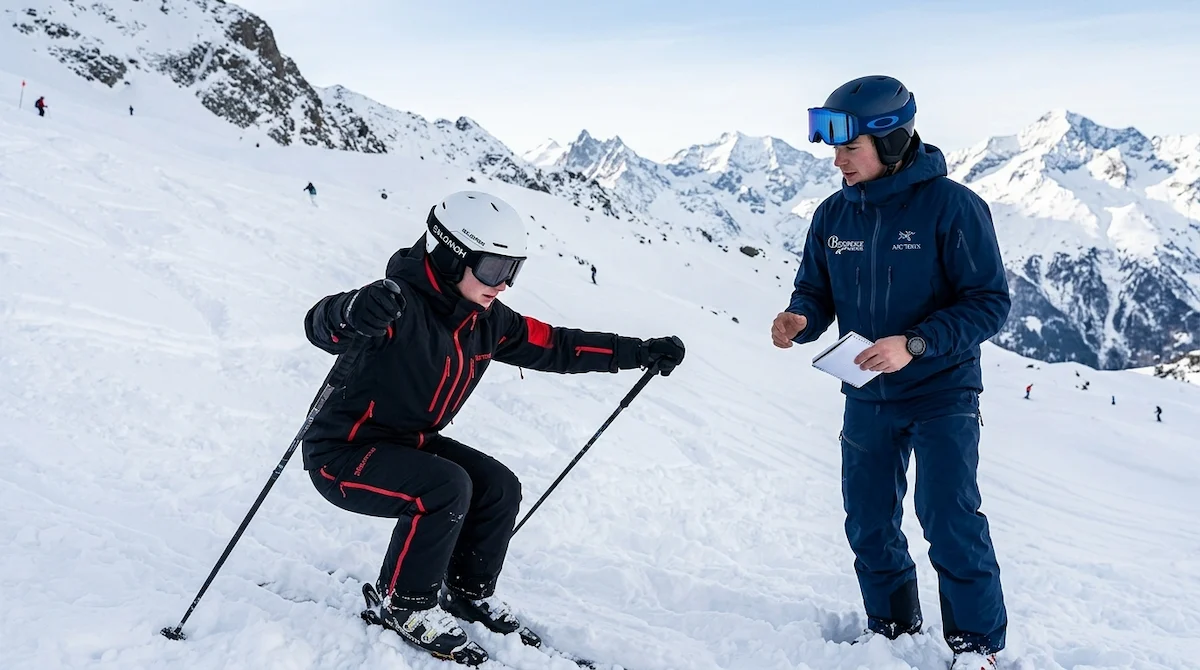
Preparing for a trip to the Val d’Anniviers region involves more than just packing your favorite goggles and checking the snow report. Grimentz-Zinal is a high-altitude playground that demands respect, offering some of the most technical and rewarding terrain in Switzerland.
Whether you plan to explore the steep chutes above Zinal or enjoy the long, winding runs back into the historic village of Grimentz, your physical readiness determines how much you will enjoy the experience.
A proper ski fitness preparation program ensures that your muscles can handle the vertical drop and your lungs can manage the thin air at nearly 3,000 meters.
Skiing at an elite level is a multi-dimensional athletic endeavor. It requires a blend of strength, agility, and metabolic efficiency. When you work with us at Bespoke Snowsport, we often see that technical progress is closely linked to physical capacity.
If your legs are tired by noon, your form will naturally suffer, leading to back-seat skiing and reduced control. By focusing on your body before you arrive, you transform your vacation from a simple trip into a high-performance experience. This article provides the technical roadmap you need to arrive in the Swiss Alps ready to perform.
Grimentz-Zinal is well-known for its verticality. The descent from the top of the Sorebois cable car down to the village is a leg-burning journey that tests even the most seasoned athletes.
To get the most out of your private lessons or your solo exploration, you need to build a foundation that mimics the demands of the mountain. We will look at specific movements and physiological adaptations that will help you stay out on the snow from the first lift to the last run, ensuring every turn is as precise as the first.
Content
Building a strong foundation for high-altitude performance
The Swiss Alps present a unique set of challenges that differ from smaller resorts. In Grimentz-Zinal, the altitude is a significant factor. Most of the skiing takes place between 2,100 and 2,900 meters. At these heights, the air is thinner, and your heart has to work harder to deliver oxygen to your working muscles.
This is why incorporating cardio for high altitude into your routine at least eight weeks before your trip is a smart move. You want to focus on activities that increase your aerobic capacity while also challenging your anaerobic threshold.
Aerobic endurance and lung capacity
To handle the long runs in the Val d’Anniviers, your cardiovascular system needs to be efficient. Long-distance running, cycling, or swimming are excellent ways to build a base. However, for skiing, interval training is often more effective.
High-intensity interval training (HIIT) mimics the stop-and-go nature of skiing, where you might have two minutes of intense effort followed by a short rest on the lift. Try to include sessions where you push your heart rate to 85% of its maximum for short bursts.
Another effective method for cardio at high altitude involves steady-state training at a moderate intensity for 60 to 90 minutes. This builds the “slow-twitch” muscle fibers that help you stay on your feet all day.
If you have access to a stair climber or a treadmill with a steep incline, use it. Hiking uphill with a weighted pack is one of the best ways to prepare your heart and lungs for the steep ascent to the Orzival area or the walk back from a hidden powder stash.
Balance and proprioception on varied terrain
Skiing isn’t just about strength; it is about how your brain communicates with your muscles to maintain balance on uneven surfaces. Grimentz-Zinal is known for its incredible off-piste and freeride zones.
When you are skiing through variable snow or moguls, your body is constantly making micro-adjustments. Proprioception is your body’s ability to sense its position in space. You can train this by using balance boards, BOSU balls, or simply practicing single-leg exercises.
Try standing on one leg while brushing your teeth or doing single-leg deadlifts. These movements strengthen the small stabilizer muscles around your ankles and knees. In our technical coaching, we emphasize the importance of a stable platform.
If your stabilizers are weak, your larger muscle groups have to work twice as difficult to keep you upright, leading to faster fatigue. Improving your balance allows you to stay centered over your skis, even when the snow conditions change from groomed corduroy to wind-blown crust.
Mobility for technical precision
Many skiers focus solely on strength, but mobility is what allows you to achieve the extreme edge angles seen in high-performance carving. If your hips are tight, you will struggle to separate your upper body from your lower body, which is a key technical requirement for short turns on steep slopes like the “Chamois” run in Zinal. Incorporating a dedicated mobility routine that focuses on the hips, ankles, and thoracic spine will make your movements more fluid.
Yoga and Pilates are excellent supplements to a skiing program. They focus on functional range of motion and help you avoid the stiffness that often comes after a long day on the mountain.
Focus on opening your hip flexors and strengthening your glute medius. These muscles are responsible for lateral stability and will help you drive your skis into the turn with more power and less effort.
Specific training protocols for the Swiss terrain
Once you have a solid aerobic base, it is time to focus on the specific muscle groups that do the heavy lifting on the slopes. Skiing is an eccentric-dominant sport, meaning your muscles are often lengthening under tension as you resist the forces of gravity and centrifugal force.
This is why your legs often feel like they are “burning” halfway down a long run. To combat this, your pre-skiing workout should include a mix of strength, power, and endurance exercises.
Strength training for downhill control
The primary movers in skiing are your quadriceps, hamstrings, and glutes. However, the way you train them matters. Traditional squats are great, but adding an eccentric focus—where you lower yourself very slowly—will better prepare you for the demands of a descent. Bulgarian split squats and lateral lunges are particularly effective because they work each leg independently and mimic the side-to-side motion of skiing.
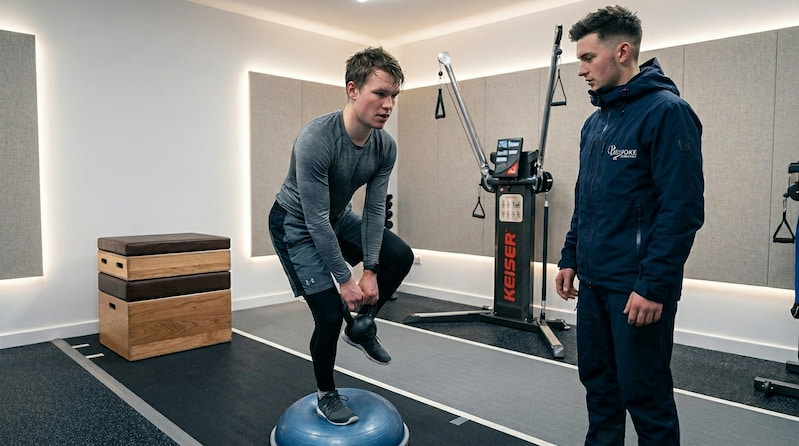
In addition to traditional weights, consider plyometric exercises. Box jumps or lateral bounds help develop the explosive power needed for quick transitions in the trees or navigating through a mogul field.
When you are in Grimentz, you might find yourself in the “Combe de Durand,” where the snow can be deep and heavy. Having the power to “pop” out of the snow and initiate the next turn is a game-changer.
Core stability and rotational power
Your core is the bridge between your upper and lower body. In skiing, a strong core allows you to maintain a quiet upper body while your legs work beneath you. This is why core strength for skiers is a major focus in our high-end coaching sessions. Without a stable midsection, the energy you generate from your legs is lost, and you will find it much harder to hold an edge on icy or steep sections.
Exercises like planks, Russian twists, and “dead bugs” are effective for building the type of stability needed. However, you should also include anti-rotational exercises like the Pallof press.
This trains your body to resist unwanted rotation, which is vital when you hit a bump or an unexpected change in snow density. A strong core also protects your lower back, which can often take a beating during a full week of intense skiing.
Functional movements for off-piste adventures
Grimentz-Zinal is a freeride paradise. Skiing off-piste requires a different kind of fitness than cruising on groomed runs. You need to be able to handle sudden impacts and maintain a high level of agility.
Your pre-skiing workout should reflect this by including multi-directional movements. Instead of just moving forward and backward, incorporate exercises that require you to move laterally and rotationally.
Kettlebell swings are excellent for developing posterior chain strength, while “skater jumps” improve your lateral power and landing mechanics. As we saw earlier, balance is vital, and these functional movements help bridge the gap between gym strength and mountain performance. When you are deep in the backcountry of the Val d’Anniviers, you want to trust that your body can handle whatever the terrain throws at you.
| Exercise type | Recommended frequency | Focus area |
|---|---|---|
| Eccentric Squats | 3 times per week | Quad endurance and control |
| Lateral Bounds | 2 times per week | Side-to-side power and agility |
| Plank Variations | Daily | Core Strength for skiers |
| Interval Sprints | 2 times per week | Anaerobic capacity |
| Hip Mobility | Daily | Range of motion and edge control |
Recovery and longevity on the mountain
Skiing at a resort like Grimentz-Zinal is an endurance event that lasts for several days. Even the fittest athletes can struggle if they don’t prioritize recovery. To keep your performance high throughout your stay, you need to think about what happens after you take your boots off. High-end ski instruction isn’t just about the time on the snow; it’s about managing your energy so you can perform at your best every single day.
Post-skiing recovery routines
The first hour after you finish skiing is the most important for recovery. Your muscles are depleted of glycogen, and your body is in a state of repair. Light stretching or using a foam roller can help flush out metabolic waste and reduce muscle soreness. In Grimentz, many of our clients enjoy the local wellness facilities, which can be a great way to relax the nervous system.
Contrast baths—alternating between hot and cold water—can also be effective for reducing inflammation in the legs. This technique helps stimulate blood flow and speeds up the healing process of micro-tears in the muscle fibers. If you want to maintain your technical level throughout the week, you cannot ignore the importance of a dedicated recovery routine. It is the difference between feeling fresh on day five and struggling to make it out of bed.
Nutrition and hydration at altitude
Eating for performance is a vital part of your preparation. At high altitudes, your body burns more calories just to maintain its basic functions. You need a diet rich in complex carbohydrates to fuel your muscles and high-quality proteins to aid in repair. Please remember the importance of healthy fats, which provide long-lasting energy for those cold days on the Tsarva glacier.
Hydration is perhaps the most overlooked aspect of mountain fitness. The air in the Swiss Alps is very dry, and you lose a significant amount of fluid through respiration. Dehydration leads to fatigue, headaches, and a decrease in cognitive function, which can be dangerous when skiing technical terrain. Aim to drink significantly more water than you would at sea level, and consider adding electrolytes to your water to replace the salts lost through sweat.
Mental resilience and injury avoidance
Skiing is as much a mental game as it is a physical one. When you are standing at the top of a steep couloir in Zinal, your mental state will dictate your performance. Being physically fit gives you the confidence to tackle these challenges. However, you also need to understand your limits. Most injuries happen at the end of the day when fatigue sets in and focus wavers. This is where ski injury prevention becomes a conscious practice.
Listen to your body. If you feel your form slipping or your legs shaking, it might be time to call it a day or take a long break. Our instructors are experts at reading these signs and will adjust the intensity of your lesson to match your energy levels. By combining physical readiness with smart decision-making, you significantly reduce the risk of common issues like ACL strains or meniscus tears.
Integrating fitness with elite technical coaching
Physical fitness is the engine, but technique is the steering wheel. You can be the strongest athlete in the world, but without the right technical foundations, you will waste energy and limit your potential on the mountain. This is where the personalized approach of Bespoke Snowsport makes a difference. We take your physical capabilities and show you how to use them efficiently on the unique terrain of Grimentz-Zinal.
Technical drills to maximize your strength
During our private lessons, we often use specific drills that highlight the connection between your fitness and your skiing. For example, we might work on “stomp” turns to test your leg power or “thousand-step” turns to challenge your aerobic capacity and coordination. These exercises are designed to take your gym training and translate it into real-world mountain skills.
As you may have noticed in this article, we emphasize the importance of the posterior chain. In our technical sessions, we will show you how to engage your glutes and hamstrings to stay balanced over your skis, even in deep powder. This improves your performance and acts as a form of ski injury prevention by taking the pressure off your knee joints. The goal is to make skiing feel effortless, regardless of the conditions.
The advantage of personalized instruction
Every skier is different. Some of our clients are elite marathon runners who need to work on their lateral power, while others are strength athletes who need to improve their aerobic base. Our “consultancy” approach means we don’t just give you a standard lesson; we analyze your physical profile and tailor our coaching to help you go beyond your current limits.
In Grimentz-Zinal, the terrain is your classroom. We might spend the morning working on high-speed carving on the wide-open reds of Grimentz and then head over to Zinal in the afternoon to test your agility in the steep trees. This variety ensures that every aspect of your fitness is challenged and refined. By the end of your time with us, you will have a much deeper understanding of how your body and your skis work together.
Preparing for the freeride experience
If your goal is to explore the world-class freeride terrain in the Val d’Anniviers, your fitness needs to be at its peak. Skiing untracked powder is incredibly demanding on the cardiovascular system and the legs. We offer specialized coaching for those looking to venture off-piste, focusing on safety, mountain awareness, and the technical skills needed to handle variable snow.
Before heading into the backcountry, we ensure that your leg exercises for skiing have prepared you for the deep flexions and rapid extensions required in powder. We also cover the use of safety equipment and how to move efficiently through the mountains. This holistic approach ensures that you are not only fit enough for the challenge but also have the knowledge and skills to enjoy it safely.
Your journey to the next level starts here
Taking your skiing to the elite level requires a commitment to both your physical conditioning and your technical development. Grimentz-Zinal offers some of the most spectacular and challenging skiing in the world, and being prepared allows you to experience it to the fullest. By following a structured ski fitness preparation plan, you ensure that your body is ready for the high-altitude demands of the Val d’Anniviers.
At Bespoke Snowsport, we are here to help you bridge the gap between your current level and your ultimate goals. Our high-end private and personalized instruction is designed to transform your experience, turning every run into an opportunity for growth and discovery. Whether you are a beginner looking for a solid start or a professional seeking to refine your technique on expert terrain, we have the expertise to guide you.
The mountains are waiting, and there is no better feeling than clicking into your bindings knowing you are at the top of your game. We invite you to join us in Grimentz-Zinal for a skiing experience that goes beyond the conventional. Our team is ready to provide the technical consultancy and elite training you need to master the slopes.