


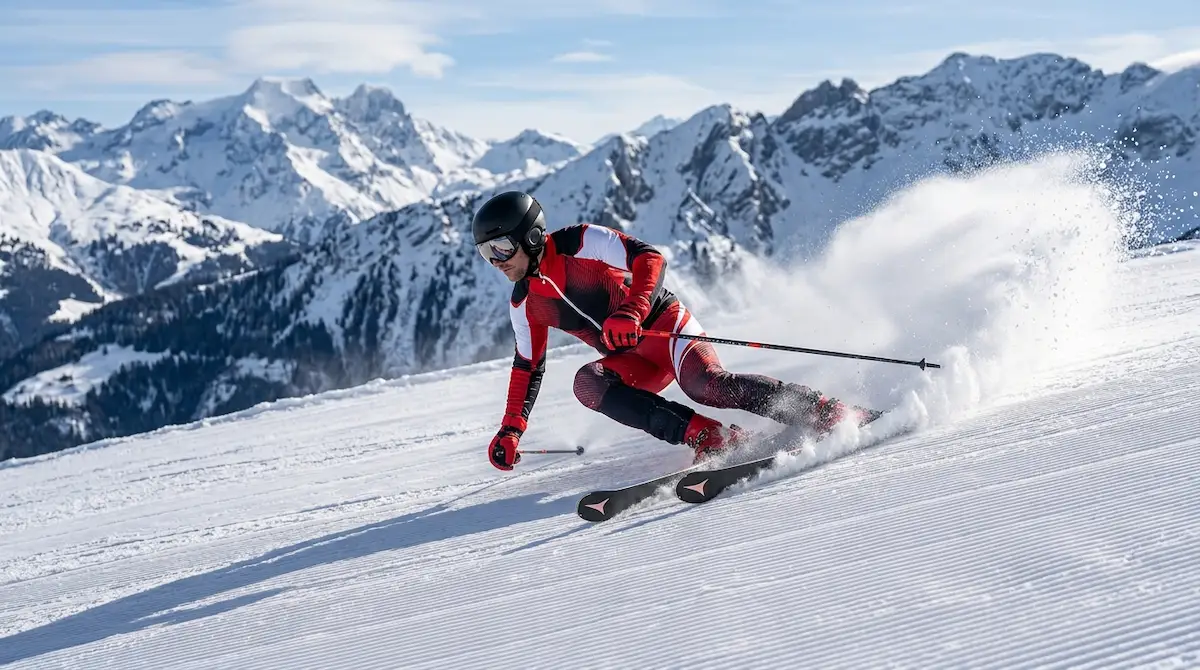
The sensation is unmistakable. It’s a feeling of pure, uninterrupted connection between you, your skis, and the snow. Instead of scraping and skidding down the mountain, you are slicing through it, your edges locked into a perfect arc like a train on a track.
There’s a quiet, hissing sound as your skis displace the snow, followed by a surge of acceleration as you exit the turn. This is the essence of a carved turn, a feeling that, once experienced, becomes the ultimate pursuit for any dedicated skier. It’s the transition from simply getting down the hill to dancing with it.
Achieving this level of performance isn’t about magic; it’s about understanding and applying a specific set of principles. It involves a deep connection between body mechanics, equipment design, and the physics of motion. Many skiers spend years chasing this feeling, making small adjustments without fully grasping the underlying concepts that unlock true, efficient carving.
They might get a taste of it on a perfect groomer but lose it the moment conditions become challenging. This guide is designed to change that. We will move beyond the surface-level tips and explore the intricate details that separate a skidded turn from a purely carved one.
This is more than just a set of instructions; it is a foundational education in the art of the arc, designed to provide you with the knowledge to analyze your own skiing and make meaningful, lasting improvements.
Our base in Grimentz-Zinal provides the perfect laboratory for this pursuit. The varied terrain, from wide, consistently pitched boulevards to steeper, more demanding faces, allows us to apply these concepts in a real-world, high-performance environment.
The principles we discuss here are universal, but they truly come to life on the pristine corduroy and challenging slopes of the Val d’Anniviers. Whether you are just moving past parallel skiing or you are an experienced skier looking to refine your technique for higher speeds and greater efficiency, the journey to a perfect carve starts with a solid foundation of knowledge.
Content
The fundamental physics of a carved turn
Before we can command our body to execute a perfect carve, we must first understand why a ski is even capable of making one. Modern skis are marvels of engineering, specifically designed to turn when placed on their edge. Grasping these core concepts is the first step in moving from being a passenger on your skis to being the pilot. It’s the “why” behind the “how,” and it’s non-negotiable for anyone serious about improving.
Understanding ski design: sidecut, camber, and flex
The most critical design element for carving is the ski’s sidecut. If you lay a ski flat on the ground and look at it from above, you’ll notice it’s wider at the tip and tail and narrower under the foot. This hourglass shape is the sidecut. The curve of this sidecut is part of a giant, imaginary circle.
When you tip the ski onto its edge, this curved shape is pressed into the snow. As you move forward and apply pressure, the ski is forced to follow this arc, pulling you into a clean, round turn. The radius of this imaginary circle is the ski’s “turn radius,” often printed on the ski itself (e.g., 15 m). A smaller radius means a quicker, tighter turning ski, while a larger radius promotes longer, more stable arcs.
Camber is the upward arch you see in the middle of the ski when it’s lying on a flat surface. This arch acts like a spring. When you stand on the ski and pressure it into a turn, you are flattening the camber. This distributes your weight and pressure more evenly along the entire length of the ski’s edge, from tip to tail.
This even pressure distribution is what allows the full sidecut to engage with the snow, providing the grip and stability needed for a clean carve. As you release the pressure at the end of the turn, the camber helps the ski rebound, providing energy and “pop” that propels you into the next turn.
Finally, the ski’s flex pattern—how it bends along its length (longitudinal flex) and twists (torsional stiffness)—plays a vital role. A ski that is too soft will feel unstable at speed and may not hold an edge on hard snow.
A ski that is too stiff will be demanding and unforgiving, requiring immense force to bend into its desired arc. Torsional stiffness is particularly important for edge hold. A ski that resists twisting will keep its edge in contact with the snow even when subjected to powerful forces, preventing it from washing out. Understanding how these three elements work together is the first piece of the puzzle.
The forces at play: gravity, centripetal force, and pressure
Skiing is a constant dance with physics, primarily with gravity. Gravity is what pulls you down the hill, providing the initial energy for motion. However, in carving, we are not just sliding down; we are redirecting that gravitational energy into a controlled, circular path. This is where centripetal force comes into play. Centripetal force is any force that causes an object to follow a curved path.
In skiing, this force is generated by your interaction with the snow. By tipping your skis on edge and pressuring them, you create a platform that pushes against the snow. The snow, in turn, pushes back on your skis, directing you into the arc of the turn. The more you angle your skis and your body into the hill, the greater the force you can generate, and the tighter and more dynamic your turn will become.
Pressure is the language you use to communicate with your skis. How you apply, manage, and release pressure throughout the turn dictates everything. At the start of a turn (the initiation phase), you gently apply pressure to the new edge to get it to bite into the snow.
As you move through the middle of the turn (the apex or fall line), your pressure should be at its maximum. This is where you are fully committed to the edge, bending the ski into its arc and experiencing the highest G-forces. In the final phase of the turn (the completion or finishing phase), you gradually reduce this pressure, allowing the ski to rebound and smoothly transition to the next turn.
Effective pressure management is not just about stomping on the ski. It’s a fluid, dynamic process controlled by flexing and extending your ankles, knees, and hips. It’s about feeling how the ski is reacting to the snow and making micro-adjustments to maintain that perfect, locked-in connection. Without a conscious understanding of how to manage these forces, a skier will forever be reacting to the mountain instead of commanding their path down it.
From skidding to slicing: the mechanics of a clean arc
What is the tangible difference between a skidded turn and a carved turn? A skidded turn involves rotational input from the skier. The skier turns their feet and legs to pivot the skis, and the tails of the skis slide or “skid” sideways to control speed and direction. This scrapes snow and scrubs speed. While skidding is a necessary and useful skill, it is not efficient.
A carved turn, by contrast, involves minimal rotational input. The skis are tipped on their edge, and the skier’s momentum and pressure cause the ski to bend and follow its sidecut. The tail of the ski follows the exact same path as the tip, leaving a clean, thin line in the snow—a “pencil line.”
The transition from skidding to carving is a process of unlearning old habits and building trust in your edges. It requires a fundamental shift in mindset from “turning the skis” to “tipping the skis and letting them turn.” This transition is often the biggest hurdle for intermediate skiers. They may be able to achieve a brief moment of carving but revert to skidding as soon as they feel their speed increasing or the terrain getting steeper.
True carving means the ski’s edge is engaged for the entire duration of the turn. This requires precise ski edge control, starting from a smooth transition from one set of edges to the other. The goal is to have a moment of weightlessness between turns where the skis are flat, followed by a progressive roll of the ankles and knees to engage the new edges.
Any abrupt, jerky movements will break this delicate connection. The result of this clean engagement is not just a beautiful arc; it’s efficiency. Because you are not scraping snow to slow down, you maintain and even generate momentum through the turn, creating a fluid, powerful, and exhilarating experience. This is the ultimate goal, and it is entirely achievable with the right technical focus.
Body mechanics: the engine of the perfect carve
While the ski’s design makes carving possible, it is your body that brings it to life. Your body is the engine, the suspension, and the steering system all in one. Every movement, from the subtle flex of your ankle to the position of your head, has a direct impact on how your skis interact with the snow.
Achieving a state of dynamic, athletic balance is the key to unlocking your body’s potential and allowing the skis to do their job. This section focuses on building the correct biomechanical habits from the ground up.
The kinetic chain: from your boots to your shoulders
Think of your body as a “kinetic chain,” where movement in one joint affects all the others. Effective carving relies on this chain working in perfect harmony. It all starts with your feet and ankles. Your ski boots are the most critical piece of equipment because they are the direct interface between you and your skis. Inside the boot, your foot should be secure but not constricted.
Any sloppiness or movement inside the boot will translate to a delayed or muted response from the ski. The ability to flex your ankle forward is paramount. This forward pressure on the tongue of the boot is what engages the tip of the ski at the beginning of the turn, allowing the sidecut to bite into the snow. Many skiers make the mistake of sitting back, which puts them behind the ski’s power and makes carving impossible.
From the ankles, we move up to the knees. The knees are your primary steering mechanism for edging. To tip the skis on edge, you don’t just lean your whole body over. Instead, you angulate by driving your knees into the turn.
This movement, combined with rolling your ankles, allows you to achieve high edge angles while keeping your upper body relatively upright and in balance. Your hips are your center of mass.
Where your hips go, your body follows. In carving, your hips should move smoothly from inside one turn to inside the next, leading the way and committing your weight to the new turning ski.
This entire lower body system works to create angulation—the angles in your ankles, knees, and hips that allow you to balance against the forces generated in a turn. A useful visualization is to imagine keeping your belt buckle pointed down the fall line as much as possible while your legs and skis turn beneath you. This concept, known as separation, is what allows for powerful, dynamic skiing.
Stance, balance, and angulation
Your fundamental athletic stance is the platform upon which all great skiing is built. It should be both relaxed and ready for action. Here are the key components:
- Feet: Your feet should be about hip-width apart. This provides a stable base of support and allows each leg to move independently.
- Ankles and knees: Keep them flexed. Your shins should be in light but constant contact with the front of your boots. Stiff, straight legs are the enemy of good skiing. Flexion allows you to absorb terrain variations and actively pressure and release the ski.
- Hips: Your hips should be over your feet. A common mistake is to sit back, breaking at the waist and putting your weight on the tails of the skis.
- Hands and arms: Your hands should be forward and slightly out to the sides, as if you were carrying a tray. This position promotes balance and helps keep your upper body stable and facing down the hill. Dropping your hands behind you will almost always pull your weight back.
Balance in skiing is not static; it’s dynamic. You are constantly making micro-adjustments to stay centered over the middle of your skis. The goal is to maintain balance fore and aft (tip to tail) and laterally (edge to edge).
Fore/aft balance is controlled by ankle flexion. If you feel your weight shifting back, press your shins into your boots. If you feel too far forward, stand up slightly taller. Lateral balance is managed by angulation.
As the forces in the turn build, you must increase your angulation (driving your knees and hip into the hill) to counteract them and stay balanced over your outside ski.
The outside ski should support the vast majority of your weight during a carved turn. The inside ski is there for support, but the power comes from a strong, committed stance on the outside ski.
The role of the core and upper body separation
While the lower body is doing the active work of edging and steering, the upper body’s role is to provide a stable, quiet platform. A strong, engaged core is the link between your upper and lower body.
It allows you to maintain your posture and resist the rotational forces that try to twist your upper body into the turn. When your upper body follows your skis into the turn, you lose separation, your balance is compromised, and you are forced to skid to recover.
Upper body separation is the concept of keeping your torso, shoulders, and head generally oriented down the fall line while your legs and skis turn underneath you. This creates tension and torque in your core, like winding up a spring. As you finish one turn, this stored energy is released, helping to propel you into the next turn with power and quickness. This is a hallmark of advanced piste technique and is essential for dynamic, short-radius carving.
To practice this, focus on your pole plants. A well-timed pole plant is not just for timing; it helps stabilize the upper body. As you initiate a new turn, you should reach your downhill hand forward and plant your pole.
This simple action helps keep your shoulders level and facing downhill, preventing your upper body from rotating into the turn. Think of your upper body as the calm, steady cockpit of a fighter jet, while your legs are the high-performance wings, banking and turning beneath you. This separation is what allows for maximum edge angle, power, and control.
Advanced techniques and terrain adaptation
Once you have a solid grasp of the fundamental physics and body mechanics, it’s time to apply them in more challenging situations. Perfecting your carving isn’t just about making one ideal turn on a gentle, empty slope. It’s about being able to adapt your turns to different speeds, turn shapes, and snow conditions. It’s about taking the core skills and learning to modulate them with precision and confidence.
The magnificent terrain here in Grimentz-Zinal, from the wide-open Grimentz groomed runs to the steeper pitches of Zinal, offers the perfect canvas to practice this adaptability.
Mastering variable conditions on the slopes
No two runs are ever the same. A perfectly groomed run in the morning can become firm or icy in shaded spots by the afternoon. Understanding how to adapt your carving to these changes is crucial. On very firm or icy snow, precision is key. Any abrupt movements will cause the edge to lose its grip. You need to be more patient at the start of the turn, gently “squeezing” the edge into the snow rather than slamming it on.
Your movements must be smoother and more deliberate. A lower, more athletic stance will help keep your center of mass close to the snow, increasing stability. Furthermore, ensuring your skis are properly tuned with a sharp edge is non-negotiable for performance on hardpack.
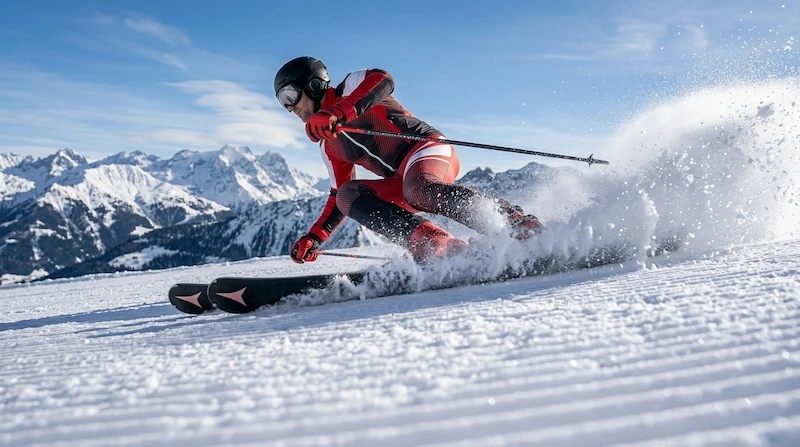
In softer, spring-like snow, you can be more aggressive with your movements. The snow is more forgiving, but it can also be grabby. It’s important to complete your turns fully, ensuring you are guiding the ski across the fall line to control your speed before starting the next arc. In variable, chopped-up snow, your legs must act as active suspension.
Constant flexion and extension of the ankles and knees are required to absorb the bumps and keep the ski edge in constant contact with the snow surface. This is where a strong core and a quiet upper body become critically important, providing the stability needed for the legs to do their work. The ability to read the snow ahead and anticipate these changes is a skill that develops with mileage and focused practice.
Dynamic carving: short, medium, and long radius turns
A truly proficient skier can change their turn shape at will. This is the difference between being a one-trick pony and being a versatile, all-mountain expert. The ability to transition between different turn radii is essential for navigating crowded slopes, adapting to changing terrain, and simply making skiing more fun and expressive.
- Long radius turns (GS Turns): These are the easiest carved turns to learn because they give you more time to think and move. They are characterized by lower edge angles and more subtle, patient movements. The focus is on a smooth, progressive buildup of pressure and a clean release. These turns are perfect for building confidence and feeling the ski’s sidecut do the work. The wide pistes in Grimentz are ideal for practicing these high-speed, stable arcs.
- Medium radius turns: This is the versatile, all-purpose turn shape. It requires a bit more angulation and a slightly quicker transition from edge to edge. This is the turn shape you will use most often, blending speed control with a dynamic, rhythmic flow down the mountain.
- Short radius turns (slalom turns): This is the most dynamic and athletic form of carving. It requires rapid edge-to-edge transitions, powerful pressure control, and excellent upper/lower body separation. The turns are quick, energetic, and require a constant rhythm. The rebound energy from one turn is actively used to initiate the next. This is where the concept of the “coiled spring” in your core truly comes into play. Mastering short-radius carving requires a high degree of skill and fitness, but it is also one of the most rewarding feelings on skis.
A great drill to improve your versatility is to practice linking different turn shapes together. For example, make three long-radius turns, then transition into five short-radius turns, and then back to long turns. This forces you to be deliberate about your movements and adapt your timing and pressure control on demand.
Pushing the limits: incorporating speed and steepness
Carving feels great on a gentle slope, but the true test comes when you add speed and steepness to the equation. As your speed increases, the forces acting on your body multiply. Small balance errors that were unnoticeable at low speeds become major problems. This is where many skiers hit a plateau. They lack the technical proficiency and confidence to stay in a carved turn when their brain is telling them to slow down.
Here are some high-speed skiing tips specifically for carving. First, you must look further ahead. At high speeds, you cover ground quickly, and you need to anticipate terrain changes well in advance. Second, your movements must become more precise and efficient.
There is no time for wasted motion. Every movement must have a purpose. Third, you must increase your angulation to balance against the greater forces. This requires a strong commitment to leaning into the turn and trusting your outside ski.
On steeper terrain, the pull of gravity is much stronger. This means you need to be more active in guiding the ski across the fall line to control your speed. The transition between turns needs to be quicker to avoid pointing your skis straight down the hill for too long. A powerful pole plant and strong core engagement are essential to maintain control and rhythm. It’s a mental game as much as a physical one.
You must have the confidence to commit to the fall line, knowing that your technique will allow you to complete the turn and manage your speed effectively. This confidence is not built overnight; it is forged through countless repetitions on progressively more challenging terrain. This is where personalized coaching can make a world of difference, providing the feedback and tactical advice needed to break through these barriers safely.
Equipment, tuning, and the mental game
Perfecting your carving technique is not just about physical movements; it’s a holistic process that includes your equipment and your mindset. The wrong gear can actively hinder your progress, fighting against your every move. Similarly, a lack of confidence can prevent you from ever committing to the techniques you’ve learned. Addressing these two areas is the final piece of the puzzle, turning good technique into truly great skiing.
Choosing the right ski for carving performance
While a great skier can ski on anything, the right ski can make the learning process infinitely easier and more enjoyable. For carving, you want a ski with a pronounced sidecut (a smaller turn radius, typically between 12-18 meters for an all-purpose carving ski) and good torsional stiffness.
A ski that is too wide underfoot (e.g., a powder ski) will be slow and cumbersome to get from edge to edge on groomed snow. Look for a ski with a waist width under 85mm for optimal on-piste performance.
The ski’s stiffness should match your weight, strength, and ability level. A lighter, less aggressive skier will be better off with a ski that has a softer flex, as they will be able to bend it and engage the sidecut more easily.
A heavier, more powerful skier will need a stiffer ski, often with layers of metal (Titanal), to provide the stability and edge hold required at high speeds. Don’t be swayed by marketing. The “best” ski is the one that is best for you. Our first session at Bespoke Snowsport often involves an equipment assessment, as we believe that aligning your gear with your goals is a fundamental first step.
The critical importance of boot fit and edge tuning
You could have the most advanced skis in the world, but if your boots don’t fit properly, you will never ski to your potential. Your boots are the steering wheel. Any slop or play between your foot and the boot shell results in a loss of control.
A proper boot fit, done by a qualified professional, is the single best investment you can make in your skiing. The boot should hold your heel securely in the back, with just enough room to wiggle your toes. It should be snug, but not painfully tight. Custom footbeds can further enhance fit and performance by supporting your foot’s arch, leading to better alignment and more direct energy transfer to the ski edge.
Equally important is ski tuning. Skis come with a factory tune, but they need regular maintenance to perform their best. The two key components are the base structure and the sharpness of the edges. The bases should be waxed regularly to ensure they glide smoothly.
Most importantly, the edges must be kept sharp. A dull edge will not grip on firm snow, no matter how good your technique is. Learning how to maintain your own edges with a file guide is a valuable skill, but having them professionally tuned periodically is essential. A sharp, properly beveled edge is your connection to the mountain; it’s what gives you the confidence to lean over and trust that the ski will hold.
Overcoming fear and building confidence
The mental aspect of carving is huge. Committing to a carved turn, especially as speeds increase, requires a leap of faith. Your survival instincts might scream at you to stand up, twist your skis sideways, and skid to a stop. Overcoming this fear is a gradual process built on trust—trust in your equipment and, most importantly, trust in your technique.
The best way to build this confidence is through progressive drills. Start on a very gentle, wide slope where you feel completely safe. Practice making simple, low-angle carved turns without any fear of gaining too much speed. Focus on the feeling of the edge engaging. As you become more comfortable, gradually move to slightly steeper terrain. The key is to expand your comfort zone incrementally, not to leap into a situation that terrifies you.
Visualization can also be a powerful tool. Before you start a run, stand at the top and visualize yourself making perfect, confident, carved turns. Imagine the feeling of the edge gripping and the smooth acceleration out of the turn. This mental rehearsal primes your body for success. Remember that every expert was once a beginner. Setbacks will happen. You might catch an edge or lose your balance.
The important thing is to analyze what happened, learn from it, and try again. This is the essence of our coaching philosophy—creating a supportive, positive environment where you can push your boundaries, build real confidence, and unlock a level of performance you may not have thought possible.
Our comprehensive carving technique masterclass is designed not just to teach you how to carve on skis, but to build the deep-seated confidence required to do it anywhere, anytime.
If you have read this far, you possess the dedication required to transform your skiing. The concepts discussed here provide the blueprint, but true mastery is achieved on the snow. If you are ready to stop just skiing and start truly carving, to feel the unmatched sensation of a perfect arc on the stunning slopes of Grimentz-Zinal, we are here to guide you every step of the way.
Request any of our ski services, whether it be a private or group lesson, and let’s translate this knowledge into an unforgettable on-snow experience.