


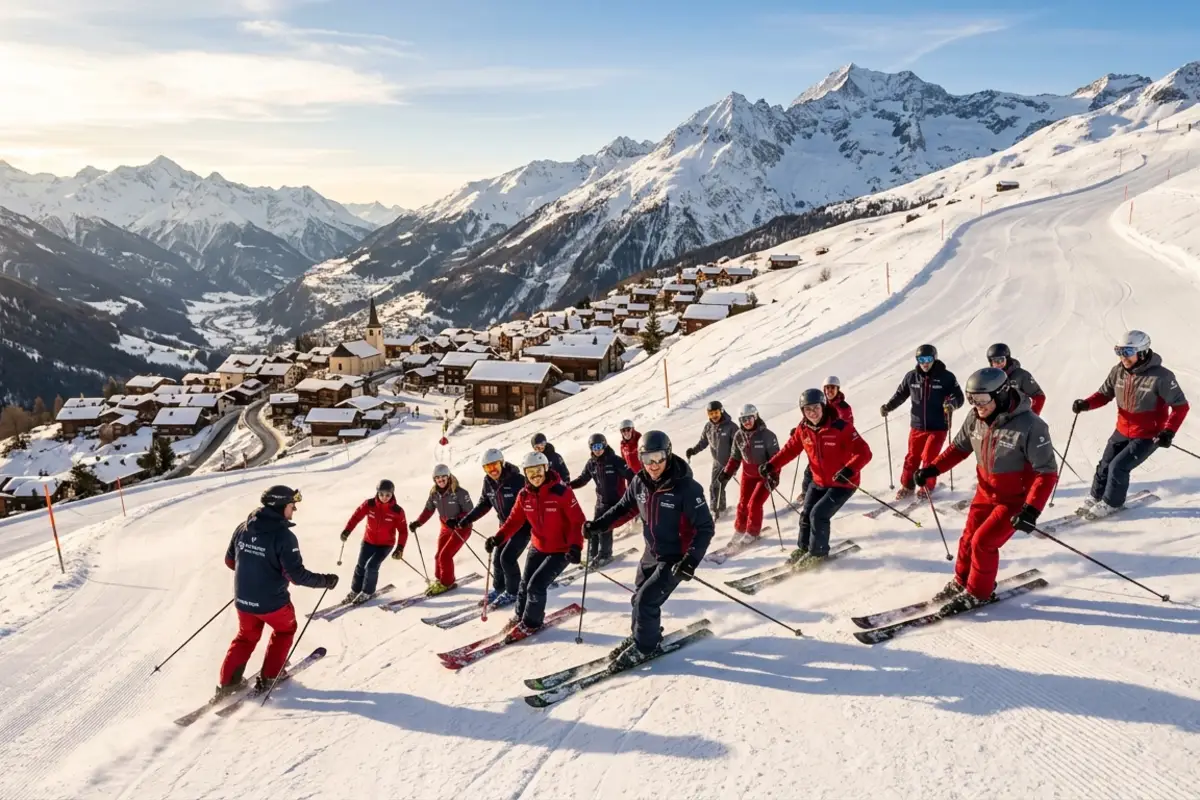
Corporate offsites and team-building events often follow a familiar script: conference rooms, trust falls, and catered dinners. While valuable, these activities can sometimes feel disconnected from the dynamic challenges of the modern workplace.
A more effective approach is to place teams in an environment that demands real-time problem-solving, clear communication, and mutual support. The alpine environment of Grimentz-Zinal offers precisely this—a natural arena for developing resilience and cohesion.
By integrating elite technical ski instruction into a corporate retreat, you can move beyond simple recreation and create a powerful metaphor for business performance.
The process of refining a turn, analyzing a line down a challenging couloir, or synchronizing movements with a partner directly mirrors the cycles of feedback, strategy, and execution that define successful teams.
This is not about simply booking a ski holiday for your staff. It is about a structured, goal-oriented experience designed to build specific skills. When a team learns to navigate the varied and demanding terrain found between the Becs de Bosson and the Diablons, they are also learning to manage risk, adapt to changing conditions, and trust in both their own capabilities and their colleagues’ support.
The immediate and tangible feedback of the mountain—a successful run, a corrected flaw in technique, or a shared moment of achievement after tackling a challenging pitch—creates a powerful learning loop.
This type of experiential development fosters a deeper level of engagement and produces insights that are more readily transferred back to the professional environment than those gained in a conventional training setting. It’s a strategic investment in your team’s ability to perform under pressure, together.
Content
The architecture of a high-impact corporate ski program
A successful corporate ski program is built on a foundation of clear objectives. It begins with understanding what your team needs to develop. Are you looking to improve communication between departments? Foster leadership skills in emerging managers? Or simply reward your team with an unforgettable experience that reinforces a culture of excellence?
The structure of the program, from the technical focus of the on-snow sessions to the format of the après-ski debriefs, should be tailored to these goals. We believe the mountain is a laboratory for performance, and our role is to design the right experiments for your team.
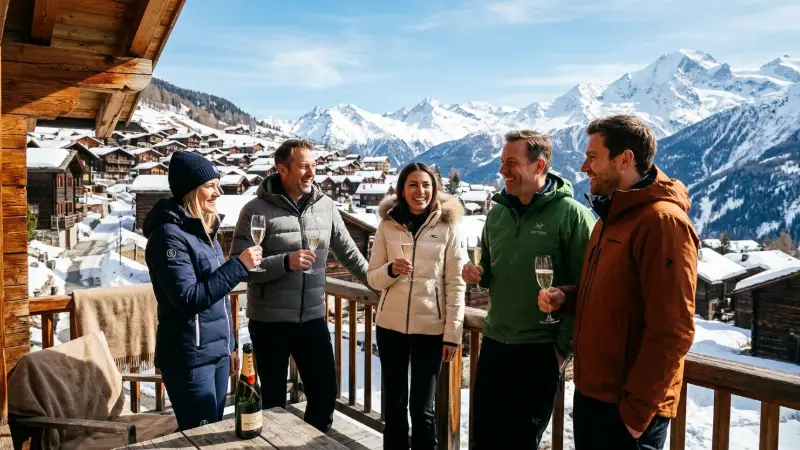
This means moving beyond a one-size-fits-all lesson plan and creating a bespoke curriculum that addresses your specific business challenges through the medium of skiing.
Defining objectives: From team cohesion to leadership development
The first step is a collaborative consultation to identify your key objectives. A sales team might benefit from a program focused on competitive, yet supportive, goal-setting, perhaps through timed runs or synchronized skiing exercises.
An engineering team, on the other hand, might find more value in sessions centered on methodical problem-solving and risk analysis, such as learning to read and navigate off-piste terrain.
For executive leadership, the focus could be on decision-making under pressure and clear communication, using challenging descents to simulate high-stakes business scenarios.
By defining these goals upfront, we ensure that every moment on the mountain is purposeful. For instance, a common objective is to break down silos between departments.
We can structure groups with members from different teams and assign tasks that require them to rely on each other’s unique skills to navigate a specific route, like the journey from the top of the Corne de Sorebois down to the village, which requires planning and teamwork.
Personalized instruction for diverse skill levels
A common concern for organizers is the wide range of skiing abilities within a typical corporate group. This is where personalized instruction becomes indispensable. The goal is to challenge every individual appropriately, ensuring that no one is left behind or held back.
Our approach involves a careful initial assessment to create small, cohesive groups based on skill, confidence, and personal goals. A complete beginner might spend their first day building a strong foundation on the gentle slopes at the Bendolla mid-station, focusing on balance and control.
Simultaneously, an expert group could be tackling the technical off-piste terrain accessible from the Grands Plans lift, working on advanced techniques for variable snow conditions. This stratification ensures that every participant is engaged in a meaningful learning process.
The instruction is not just about skiing better; it’s about building confidence and resilience. The sense of accomplishment a novice feels after linking their first parallel turns is just as powerful as the thrill an advanced skier experiences after a successful descent of a challenging couloir.
Integrating on-snow learning with business principles
The true value of this experience lies in connecting the on-piste activities to off-piste professional life. This is achieved through structured feedback and facilitated debrief sessions. After a morning session focused on line choice and adapting to changing snow, a debrief might explore how these concepts relate to market adaptability and strategic planning.
A video analysis of a skier’s technique can become a powerful discussion on the importance of constructive feedback and incremental improvement. We facilitate these conversations, helping participants draw parallels between their performance on the snow and their roles within the company.
For example, the process of planning a descent in an off-piste area like the Chamois couloir involves assessing conditions (market research), communicating a plan (strategy), executing it with precision (project management), and providing mutual support (teamwork). By making these connections explicit, the lessons learned on the mountain become durable, actionable business insights.
The Grimentz-Zinal advantage: A world-class environment for development
The choice of location for a corporate event is far from trivial. It sets the tone and provides the raw materials for the experience. Grimentz-Zinal, nestled deep in the Val d’Anniviers, is not just another ski resort; it is an environment that inspires and challenges in equal measure.
Its unique combination of authentic alpine charm, extensive and varied terrain, and reliable snow conditions makes it an ideal setting for a high-impact corporate program. The resort’s layout, connecting two distinct villages and their respective ski areas, offers a natural sense of journey and exploration.
This is not a manufactured experience; it is an authentic immersion into a high-performance environment that demands respect, focus, and skill—qualities that are directly transferable to the business world.
Terrain as a training tool: From groomed pistes to freeride zones
The diversity of terrain in Grimentz-Zinal is a significant asset. It allows us to create a progressive and varied curriculum for any skill level. The wide, perfectly groomed pistes of the Zinal sector are ideal for focusing on pure carving technique and building a solid technical foundation.
Here, we can use video analysis to deconstruct every phase of the turn, focusing on balance, edge angle, and pressure control. For more advanced teams, the resort opens up a world of possibilities.
The legendary freeride terrain, including the Gardes de Bordon and the area around the Col de Lona, provides a real-world classroom for risk management, decision-making, and teamwork.
Navigating this terrain safely requires constant communication, situational awareness, and trust among group members. The ability to move from a controlled, predictable environment (a groomed run) to a complex, unpredictable one (off-piste) serves as a powerful metaphor for navigating the business landscape.
Logistics and atmosphere: An environment conducive to focus
Beyond the slopes, the Val d’Anniviers provides an atmosphere that encourages connection and reflection. The traditional villages of Grimentz and Zinal, with their sun-blackened wooden chalets and tranquil ambiance, offer a welcome respite from the pressures of city life. This sense of removal from the everyday helps participants to be more present and engaged in the experience. The logistics are also streamlined.
The efficient lift system, including the cable car that links the two ski areas, minimizes downtime and maximizes time on the snow. High-quality mountain restaurants, like the Cabane de la Tracuit or the Restaurant de Sorebois, provide excellent venues for on-mountain lunches and informal debriefs.
This combination of world-class infrastructure and authentic alpine culture creates an environment where teams can focus on their development without distraction, fostering a sense of camaraderie and shared purpose that lasts long after the trip is over.
Building a curriculum: Sample modules for your team
To illustrate how these principles translate into practice, consider a few sample modules that can be combined and customized to form a multi-day corporate program. Each module is designed around a core theme that links a specific set of ski skills to a corresponding set of business competencies. The intensity and technical focus of each module are adjusted based on the group’s ability and the program’s overall objectives.
This modular approach allows for maximum flexibility, ensuring that the final itinerary is a perfect fit for your team’s needs. The goal is to create a coherent narrative for the trip, where each day builds upon the last, culminating in a final challenge that integrates all the skills learned.
Module 1: Foundations of performance and communication
This module is ideal for the first day, especially for groups with mixed abilities. The focus is on establishing a strong technical base and clear communication protocols. For skiers, this means refining the fundamental mechanics of a balanced stance, effective edge control, and smooth turn initiation.
We use specific drills on groomed terrain to isolate these movements, providing constant feedback. In parallel, we introduce communication exercises. For example, pairs of skiers might practice following each other’s lines precisely, requiring the lead skier to make clear, predictable movements and the following skier to be highly observant.
The business parallel is clear: establishing a shared language and standard operating procedures is the foundation of any high-performing team. The debrief focuses on the importance of clarity, consistency, and active listening in both skiing and business contexts.
Module 2: Adaptability and decision-making in variable conditions
Building on the foundational skills, this module introduces complexity and uncertainty. We move to more varied terrain, such as ungroomed pistes or the edges of the trail, where the snow conditions can change from one turn to the next.
The technical focus shifts to adapting technique—adjusting stance, turn shape, and timing to handle moguls, crud, or soft snow. The core competency being developed here is adaptability.
We create scenarios that require the group to make decisions on the fly: choosing the best line through a mogul field, deciding when to ski aggressively and when to be more conservative. This module is particularly relevant for teams that operate in fast-changing markets.
The debrief session explores how the team managed uncertainty, how they made decisions collectively, and how they can apply these lessons to their strategic planning processes back in the office.
Module 3: Advanced problem-solving and risk management
This module is designed for more experienced groups and focuses on off-piste skiing. It is a masterclass in risk assessment, planning, and execution. The day begins with avalanche safety training, including beacon search practice, which immediately establishes a serious, professional tone.
The on-snow portion involves navigating challenging freeride terrain, which requires the group to work as a cohesive unit. They must analyze the snowpack, choose a safe route, communicate intentions clearly, and manage the group’s descent one skier at a time.
The instructor acts as a facilitator, guiding the group’s decision-making process rather than simply dictating the line. This is a powerful leadership development exercise.
The experience of successfully navigating a complex and potentially hazardous environment as a team builds immense trust and confidence. The connection to managing high-stakes business projects with multiple variables and potential risks is direct and impactful.
Measuring success: The return on investment of a performance ski trip
An investment in a high-end corporate ski program should deliver tangible returns. While the immediate benefits of improved morale and a shared, memorable experience are obvious, the long-term impact on team performance and business outcomes is the true measure of success.
The value is not in the lift tickets and hotel rooms; it is in the observable changes in how your team communicates, collaborates, and confronts challenges. We believe in defining metrics for success from the outset and providing a framework for evaluating the program’s impact long after the snow has melted. This transforms the trip from a discretionary expense into a strategic investment in human capital.
Short-term impact: Improved morale and immediate skill acquisition
The most immediate and visible outcome of a well-executed program is a significant boost in team morale. The shared challenge and accomplishment of learning and performing in a beautiful but demanding environment creates strong bonds. Participants leave with a renewed sense of energy and a deeper connection to their colleagues.
They also leave with a new or improved skill, which provides a powerful sense of personal achievement. This feeling of competence and confidence is a powerful antidote to workplace burnout.
We often hear from participants that the focus and flow state they achieve while skiing is something they strive to replicate in their professional work. These short-term benefits create a positive cultural ripple effect that can be felt across the organization.
Long-term benefits: Enhanced communication and problem-solving
The more profound benefits emerge in the weeks and months following the trip. Teams that have learned to communicate effectively on a windswept mountain ridge are better equipped to handle a tense project meeting.
Managers who have guided their group down a challenging couloir have a more in-depth understanding of situational leadership. The shared vocabulary and experiences from the trip become a new framework for discussing performance and collaboration.
A manager might say, “We need to approach this project like we approached the Chamois descent: one controlled turn at a time, with everyone watching out for each other.”
This is not just a quaint analogy; it is a reference to a lived, shared experience of successful execution under pressure. These are the durable skills that improve efficiency, foster innovation, and build a resilient organizational culture.
A comparative look at team-building approaches
To put the value in perspective, it is useful to compare this type of immersive, skill-based program with more traditional corporate team-building activities.
| Activity | Primary focus | Environment | Skill transferability |
|---|---|---|---|
| Traditional Seminar/Workshop | Theoretical knowledge, conceptual models | Controlled, indoor (conference room) | Moderate; requires conscious effort to apply concepts |
| Social Event (e.g., Dinner, Golf) | Relationship building, networking | Relaxed, unstructured | Low; primarily improves interpersonal rapport |
| Performance Ski Program | Experiential learning, real-time problem-solving | Dynamic, real-world (alpine environment) | High skills are learned and applied under pressure |
As the table illustrates, while other activities have their place, an immersive performance program provides a unique opportunity to develop and test critical business skills in a dynamic, real-world setting. The learning is not abstract; it is tangible, memorable, and directly applicable to the challenges of the modern workplace. It is an investment that pays dividends in the form of a more cohesive, adaptable, and high-performing team.
The ultimate goal is to create an experience that resonates long after your team has returned to the office. By combining the stunning natural laboratory of Grimentz-Zinal with a structured, goal-oriented instructional curriculum, we help you build a stronger, more resilient, and more collaborative organization.
The lessons learned on these slopes are not just about skiing; they are about performance, teamwork, and leadership. To explore how a tailored program can meet your team’s specific development needs, we invite you to get in touch. Request any of our ski services, whether it be a private or group lesson, and let’s begin designing your team’s most impactful offsite yet.