


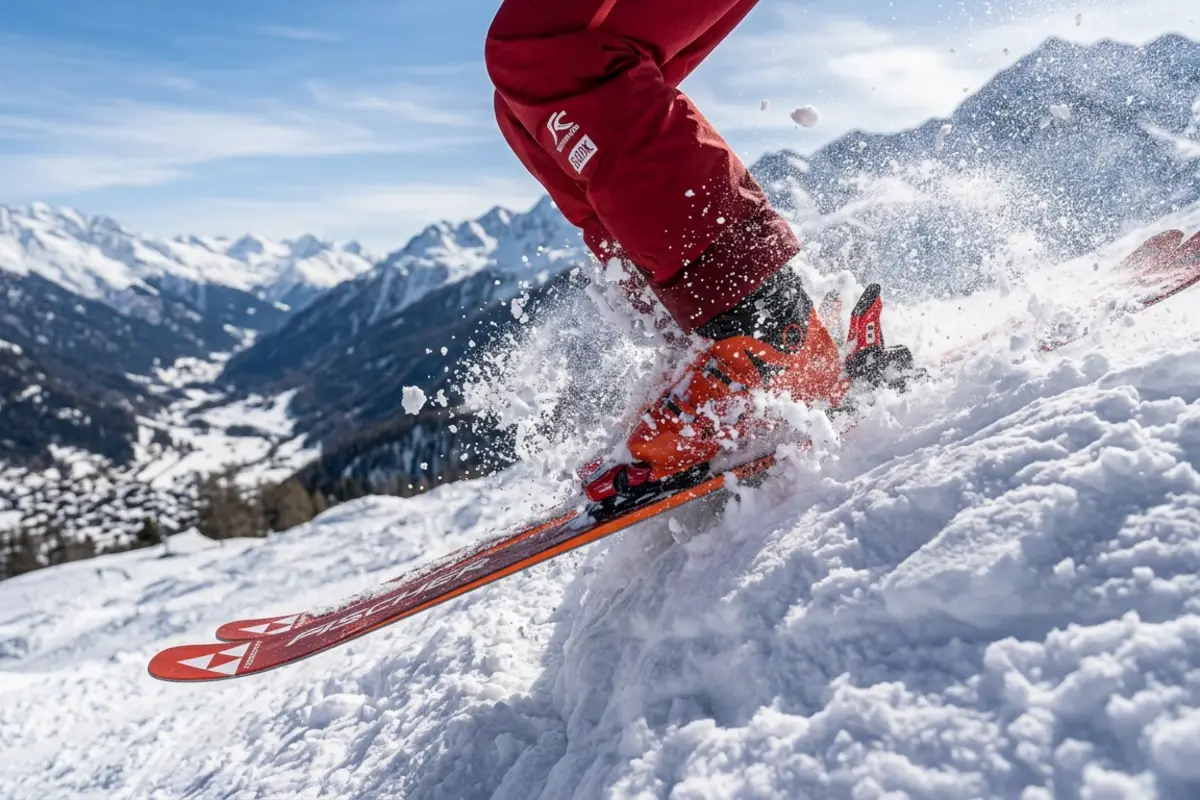
Skiing a perfectly groomed piste is a pleasure, but for many, the true test of skill and the source of the greatest satisfaction lies in successfully skiing a mogul field. The varied and challenging terrain here in Grimentz-Zinal offers some of the most rewarding bump runs in the Val d’Anniviers.
Yet, many capable skiers find themselves intimidated or exhausted by them. The common perception is that moguls require immense strength and aggressive, jarring movements. The reality is quite different.
Efficient mogul skiing is about finesse, timing, and working with the mountain, not against it. It’s a dance of absorption and extension, of precise edge control and rhythmic pole plants.
This guide will provide a technical framework to help you approach the bumps not as obstacles but as opportunities to refine your technique and elevate your skiing.
We will analyze the core components of bump skiing, from body mechanics to tactical line selection, giving you the tools to ski them with more confidence and less fatigue.
Content
Deconstructing the mogul turn: body mechanics and movement
At its core, a mogul is simply a mound of snow created by the turns of other skiers. A field of them presents a constantly changing, three-dimensional puzzle. The key to solving this puzzle lies not in overpowering the bumps, but in allowing your body to move in a way that absorbs their impact while maintaining balance and ski-to-snow contact.
This requires a departure from the wide, carving turns of the groomers and an adoption of a more dynamic, compact, and responsive stance. The movements are subtle but have a profound effect on your ability to stay in control.
The role of absorption and extension
The single most important physical skill in bump skiing is the ability to absorb pressure. As your skis travel up the front side of a mogul, your body needs to act like a suspension system. This is achieved by actively flexing your ankles, knees, and hips, allowing your legs to retract underneath your torso.
Think of your upper body remaining on a relatively stable, level plane while your legs do the work of moving up and down to accommodate the terrain. As you reach the crest of the mogul, your legs are at their most compressed.
Then, as you ski down the backside, you actively extend your legs to push the skis back down onto the snow, ensuring you maintain contact and are ready for the next bump. This continuous cycle of flexion (absorption) and extension is the engine of mogul skiing.
A common mistake is to remain stiff, which causes the skier to be launched into the air off the top of each bump, leading to a loss of control and rapid fatigue. The goal is to keep the skis on the snow as much as possible.
Maintaining a centered and forward stance
Balance is precarious in a mogul field. The constant changes in pitch and direction conspire to throw you off balance, usually into the “back seat.” To counteract this, you must consciously maintain a forward and centered stance. This means keeping your hands forward, where you can see them, and feeling pressure on the front of your ski boots. Your shins should be in constant contact with the boot tongue.
This forward pressure allows the tips of your skis to engage the snow at the beginning of the turn, giving you control. If your weight shifts back, the tips will become light, your skis will accelerate out from under you, and you will lose the ability to steer effectively.
A useful mental cue is to feel as though your core is leading you down the mountain, with your legs and skis following beneath you. This proactive posture keeps you ahead of the movements and ready to react to the terrain ahead.
The upper and lower body separation
Efficient turning in moguls requires quieting the upper body and letting the legs and feet do the steering. This concept is known as separation. Your upper body—shoulders, torso, and head—should remain stable and consistently face down the fall line (the most direct path down the slope). Meanwhile, your legs and feet pivot and rotate beneath your hips to turn the skis around each mogul. Imagine a swivel in your waist.
This separation allows for quick, agile turns without throwing your entire body’s momentum into each change of direction. When skiers turn with their whole body, they often over-rotate, face across the hill, and struggle to initiate the next turn quickly enough. By keeping your torso pointed downhill, you are always in a position to start the next turn, creating a smooth, rhythmic flow from one bump to the next.
Choosing your line: strategy and tactics on the slope
Once you understand the fundamental movements, the next layer of skill is tactical: choosing where to go. A mogul field can look like a chaotic jumble of snow, but there are distinct lines and paths through it. Your choice of line will dictate the rhythm, speed, and difficulty of your run.
A good line makes the bumps feel manageable and rhythmic; a poor line can make them feel jarring and unpredictable. Learning to read the terrain and select the best path is as much a mental skill as it is a physical one. The runs off the top of the Corne de Sorebois offer a perfect canvas for practicing this, with varied pitches and mogul formations.
The zipper line: the direct approach
The most direct and advanced line is often called the “zipper line.” This involves skiing straight down the fall line, turning on the crest of each mogul. The skis pivot in the trough (the low point between bumps) and slide up the side of the next mogul, with the turn being completed on the top. This is a fast, aggressive, and rhythmic way to ski bumps, but it requires precise timing and excellent absorption skills.
It’s the line competitive mogul skiers use. For those developing their skills, attempting a pure zipline can be too demanding. However, understanding its mechanics is valuable because elements of it are used in all other lines. The key takeaway is the concept of turning in the troughs and on the crests, which are the points of least resistance and greatest control.
The round line: a path of control
A more accessible and common approach is the “round line.” Instead of skiing straight down the fall line, you ski around the sides of the moguls. This line is less direct, which naturally helps control your speed. Your turns will happen in the troughs or on the sides of the bumps. This gives you more time and space to complete each turn before encountering the next mogul.
It’s an excellent way to build confidence and practice the rhythm of absorption and extension without the pressure of the fall line’s speed. As you become more comfortable, you can make your round line tighter and more direct, gradually transitioning closer to the zipper line.
When skiing the classic mogul fields near the Orzival lift, starting with a wide, round line and progressively tightening it is a fantastic way to build proficiency throughout the day.
Reading the terrain and adapting your path
No mogul field is perfectly uniform. Bumps can be large, small, round, sharp, close together, or spaced far apart. A truly skilled skier doesn’t just pick one type of line and stick to it; they adapt their path continuously based on the terrain ahead. This requires you to look ahead—not just at the next bump, but three or four bumps down the line. Identify patterns.
Are the moguls forming a clear channel? Is there a section where they become tighter and steeper? Is there an “escape route” to a flatter section if you lose control? Reading the terrain is about making micro-adjustments to your chosen line.
You might use a rounder turn to slow down before a steep section, then tighten it up into a more direct zipper line where the bumps are more rhythmic and predictable. This proactive approach transforms you from a passenger reacting to bumps into a pilot actively navigating the course.
The finer points of technique: pole planting and edge control
With the core movements and line strategy in place, we can refine the technique by focusing on two critical components: the pole plant and edge control. These elements are what add polish, rhythm, and efficiency to your mogul skiing.
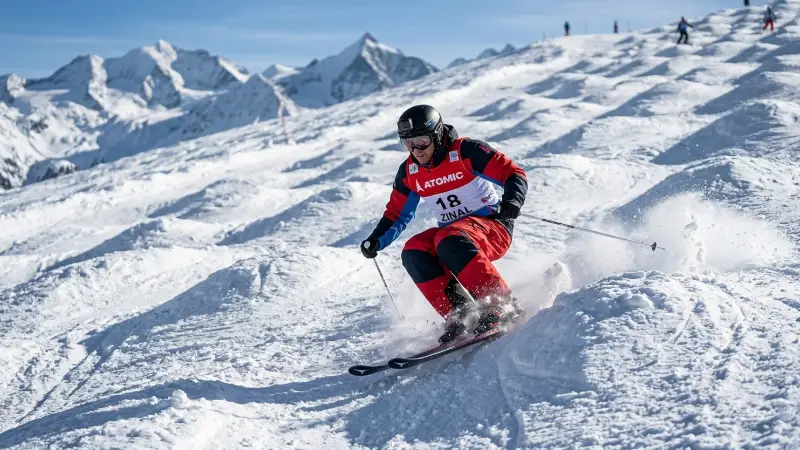
They are not just accessories to the turn; they are integral parts of it. A well-timed pole plant provides stability and initiates the turn, while precise edge control dictates your speed and grip throughout the turn. Getting these right is what separates a competent bump skier from an elegant one.
The timing and placement of the pole plant
In mogul skiing, the pole plant is not a passive gesture; it is an active, precisely timed movement that serves as the metronome for your turns. The plant should be light, quick, and deliberate. As you approach the crest of a mogul, you should reach forward and downhill with your pole, planting it on or near the top of the bump. This plant acts as a trigger for your turn initiation.
The moment the pole touches the snow, you should begin to pivot your skis around it. This timing is crucial. Planting too early or too late disrupts the rhythm. The placement is equally important.
The pole should be planted in a way that helps you move your body forward and down the hill into the next turn, not as a brake to lean back on. It’s a touch, not a push. A light flick of the wrist is all that’s needed. This consistent, rhythmic pole plant provides a point of stability in a constantly moving environment and helps drive you through the turn sequence.
Using the edges for speed management
While groomer skiing often emphasizes carving on high edge angles, mogul skiing requires a more subtle use of your edges. The primary method of turning in bumps is pivoting or skidding the skis, with edge grip used strategically for speed control. At the top of the mogul, as you complete your turn, you can increase the edge angle to scrub speed before entering the next trough.
As your skis are in the trough and moving onto the next bump, the edge angle should be flatter to allow the skis to pivot easily. A common error is to try and carve a turn around a mogul.
The shape of the bump makes this nearly impossible and often results in the ski edge catching abruptly, throwing the skier off balance. Instead, think of your skis as being relatively flat for the steering portion of the turn and then rolled onto their edges for the “braking” or control portion. This blend of skidding and edging allows for both agility and speed regulation.
Drills for improving mogul technique
Improving your bump skiing doesn’t always have to happen in a full-blown mogul field. There are several drills you can practice on gentler terrain or on the sides of pistes to build the necessary skills.
- Absorption traverse: Find a run with some natural rollers or small bumps. Traverse across the slope without turning, focusing solely on absorbing the bumps by flexing your ankles and knees. Keep your hands forward and your upper body still. This isolates the feeling of absorption.
- Fall line pivots: On a groomed blue run, practice making quick pivot turns with your skis staying in the fall line. Focus on keeping your upper body facing downhill and using your legs and feet to steer. This builds the muscle memory for separation.
- One-pole skiing: Skiing with only your downhill pole forces you to focus on balance and proper turn initiation. It prevents you from relying on the inside pole for balance and encourages a forward stance.
Practicing these drills can significantly accelerate your progress when you return to the dedicated mogul runs.
Putting it all together: rhythm, flow, and mindset
Mogul skiing is a holistic activity. You can have perfect individual techniques, but if they don’t connect into a fluid, continuous motion, you will still struggle. The final piece of the puzzle is bringing together the body mechanics, line choice, pole planting, and edging into a seamless performance.
This is where rhythm and flow come in. It’s also where your mental approach plays a significant role. Approaching a mogul field with tension and fear will lead to stiff, defensive skiing. Approaching it with a relaxed, confident, and proactive mindset will allow your body to perform the movements you’ve learned.
Finding your rhythm
Rhythm is the heartbeat of mogul skiing. It’s the consistent timing between your absorption, extension, pole plant, and turn. The terrain often dictates a natural rhythm. Your job is to tune into it. Start by counting your turns: “one, two, one, two…” This can help establish a consistent tempo.
Music can also be a powerful tool; skiing with headphones (with the volume low for safety) and a song with a steady beat can help your body internalize a rhythm. Don’t force a rhythm that’s too fast for you.
Start slowly on a gentler pitch, find a comfortable cadence, and then gradually increase your speed as your confidence and skill grow. The goal is to make the movements automatic so you can focus on reading the terrain ahead rather than thinking about each individual motion. The flow state that many advanced skiers describe is simply a state of being perfectly in sync with this rhythm.
The psychological aspect of bump skiing
Your mindset is arguably as important as your physical technique. Mogul fields can be visually intimidating. Looking down a steep, bumpy run can trigger a fear response that makes your muscles tense up. This is the enemy of good mogul skiing, which requires a relaxed and supple body. It is important to manage this. Start on easier mogul runs. Ski only a few turns at a time, then stop, regroup, and go again.
This builds confidence in small, manageable chunks. Focus on the process, not the outcome. Instead of thinking, “I have to get to the bottom,” think, “I’m going to make three good turns.” Celebrate small victories. Acknowledge that you will make mistakes, and that’s part of the learning process. A positive and patient mindset will allow you to relax, which in turn will allow your body to perform the fluid motions required.
Comparing common mogul skiing approaches
Different skiers may prioritize different aspects of mogul technique. Here is a comparison of two common stylistic approaches, often seen as a spectrum from pure control to pure performance.
| Feature | The control approach | The performance approach |
|---|---|---|
| Line Choice | Primarily a round line, skiing around the bumps to manage speed. | Primarily a zipline, skiing a direct fall line over the top of the bumps. |
| Turn Shape | More completed, C-shaped turns in the troughs, often with a distinct speed-checking phase. | Quick, shallow pivots with continuous momentum. Turns are for direction change, not braking. |
| Body Position | Slightly more upright, with a strong focus on absorption to maintain stability. | More compressed and athletic, with active extension to maintain snow contact at high speed. |
| Primary Goal | To descend the run safely, smoothly, and with minimal fatigue. | To descend the run as quickly and efficiently as possible, with a dynamic rhythm. |
Most recreational skiers will find themselves somewhere between these two approaches. Our coaching philosophy at Bespoke Snowsport focuses on building a solid foundation based on the control approach, then layering on elements of the performance approach as the skier’s skill and confidence develop. This ensures a sustainable progression.
Mastering the bumps is a journey, one that offers immense rewards in terms of skill development and personal satisfaction. It transforms your perception of the mountain, opening up new terrain and challenges.
The techniques discussed here—absorption, a forward stance, separation, line choice, and rhythmic pole planting—are the building blocks for success. By breaking down the process and practicing the components, you can methodically build the skills needed to ski the moguls in Grimentz-Zinal and beyond with confidence and style.
If you are ready to take your skiing to the next level and turn challenging terrain into your personal playground, we are here to help you refine your technique. Request any of our ski services, whether it be a private or group lesson, and let our expert instructors provide personalized coaching to help you achieve your goals on the snow.