


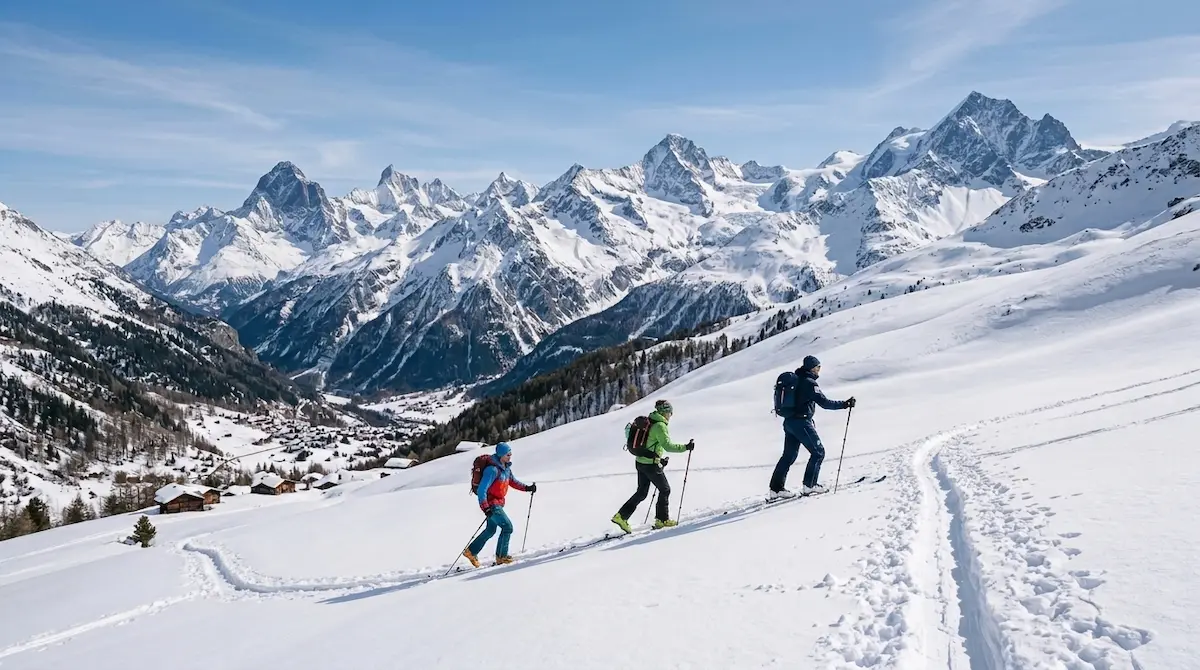
Venturing beyond the groomed pistes of a ski resort opens up a world of pristine snow, profound silence, and unparalleled mountain freedom. This is the essence of ski touring, an activity that combines the physical challenge of mountaineering with the pure joy of skiing untouched powder. For those new to the sport, the idea can be as intimidating as it is appealing.
The Val d’Anniviers, and specifically the area around Zinal, offers a uniquely suitable and spectacular environment for this first step. The terrain provides a natural progression, allowing newcomers to build skills and confidence in a controlled yet genuinely wild setting. It’s not just about leaving the lifts behind; it’s about fundamentally changing your relationship with the mountains, learning their language, and earning your turns in the most rewarding way possible.
Embarking on this journey requires more than just a desire for adventure. It demands a new set of skills, specialized equipment, and a deep respect for the alpine environment. Unlike resort skiing, where patrols and marked boundaries provide a safety net, the backcountry is self-sufficient territory. This guide is designed to demystify the process.
We will explore the foundational knowledge you need, from understanding the gear that will become an extension of your body to recognizing the basic principles of mountain safety. Our approach is built on years of guiding individuals through this exact transition.
We believe that with the right preparation and expert guidance, anyone with a solid intermediate skiing ability can successfully and safely complete their first tour. The goal is to transform apprehension into confident exploration, providing a structured pathway into the heart of the Swiss Alps.
Understanding the fundamentals of backcountry exploration
Before you can click into a pair of touring skis, it’s crucial to grasp what the activity truly entails. Ski touring, at its core, is about human-powered ascent. Using specialized bindings that allow the heel to lift freely and adhesive “skins” on the base of the skis for traction, you walk uphill on snow. Once you reach your objective, you transition your gear back into “ski mode”—locking down your heels, removing the skins—and ski down.
This simple description belies a rich and complex experience that engages you physically and mentally in a way that resort skiing rarely does. It’s a slower, more deliberate pace, where every step is part of the adventure, not just a means to get to the top of a run.
The appeal is multifaceted. For some, it is the physical challenge, a full-body workout set against a stunning alpine backdrop. For others, it is the solitude and the escape from crowded lift lines and busy slopes. It’s the thrill of finding your own line in untracked snow, a line that you earned with your own effort. This transition from being a consumer of the mountain experience to an active participant is profound.
It fosters a deeper connection to the environment, demanding that you pay attention to the weather, the snowpack, and the terrain in a way you never have to within the confines of a resort. This heightened awareness is not just for safety; it is what makes the experience so immersive and fulfilling.
What makes Zinal an ideal starting point
The Grimentz-Zinal ski area is renowned for its expert off-piste terrain, but its true strength lies in its versatility. For the aspiring ski tourer, it serves as a perfect natural classroom. The area offers an abundance of accessible, lower-angle terrain that is ideal for learning the basics without being exposed to significant objective hazards.
You can practice fundamental skills like kick-turns, efficient skinning techniques, and gear transitions in relatively safe zones that are still breathtakingly beautiful. The proximity of the lift system allows for “lift-assisted” touring, where you can use a ski lift to gain significant elevation before starting your tour.
This is a fantastic way to begin, as it conserves energy for the downhill portion and allows you to focus on technique rather than being immediately overwhelmed by a long ascent.
Furthermore, the valley’s geography provides a clear progression. As your skills and confidence grow, more challenging objectives become available. You can start with a short tour from the top of a lift to a nearby col and progress to multi-hour ascents of local peaks. This scalability is invaluable. It means you can return season after season, continually pushing your boundaries within the same familiar yet expansive valley.
The visibility of the terrain from the resort also helps; you can often see your intended route from a lift, which helps in planning and visualization. This combination of accessible introductory terrain, options for progression, and stunning scenery makes the region a premier destination for those looking to begin their backcountry journey.
The mental and physical transition from piste to powder
The first and most significant adjustment for a resort skier is the change in pace and effort. Resort skiing is largely anaerobic and gravity-fed, consisting of short bursts of intense effort followed by periods of rest on a chairlift. Ski touring is the opposite. The ascent is a sustained, aerobic activity, more akin to a long hike or a slow jog. It requires endurance, efficient movement, and energy management.
You learn to move deliberately, to find a rhythm that you can maintain for hours. This requires a different kind of fitness, one focused on cardiovascular endurance rather than leg strength alone. While strong skiing skills are essential for the descent, the ability to move efficiently uphill is what makes the day successful and enjoyable.
Mentally, the shift is just as dramatic. In a resort, most decisions are made for you. Runs are marked, avalanche control is handled by professionals, and help is a phone call away. In the backcountry, you are the decision-maker. You and your group are responsible for route finding, risk assessment, and emergency response. This requires a new mindset, one of constant observation and critical thinking.
You learn to read the snow, to interpret the weather, and to communicate effectively with your partners. It’s a shift from passive recreation to active expedition. This responsibility can seem daunting, but it is also empowering.
With proper training, you develop the competence to make sound judgments, turning the vast, untamed mountains from a place of uncertainty into a landscape of opportunity. This is where professional instruction is not just beneficial but essential, providing the framework for developing this crucial mountain sense.
Essential equipment for your first backcountry day
Stepping into the world of ski touring means stepping into a new set of equipment. While some gear may look familiar, its functionality is purpose-built for the dual demands of ascending and descending. Understanding your equipment is the first step toward self-sufficiency in the mountains. It’s not just about owning the gear; it’s about knowing how it works, how to use it efficiently, and how to troubleshoot it in the field.
A minor binding issue or a skin failure can quickly turn a pleasant day into a challenging ordeal. We emphasize hands-on familiarity with every piece of your kit before you even set foot on the snow. Your gear is your lifeline, your toolkit for adventure, and your partner in the mountains. Investing in quality equipment and, more importantly, in the knowledge of how to use it, is the best investment you can make in your safety and enjoyment.
The market for touring gear can be overwhelming, with endless options and technical jargon. For a beginner, the focus should be on reliability, ease of use, and versatility. You don’t need the lightest, most specialized racing setup. Instead, you need a system that is forgiving, durable, and won’t add unnecessary complexity to your first few outings. It’s often wise to rent equipment for your initial tours.
This allows you to try different systems and understand what works for you before making a significant financial commitment. A good rental shop, or the equipment provided by a guide service, will ensure that your gear is appropriate for your size, ability, and the day’s objective. Let’s break down the core components you’ll need.
The touring trinity: skis, boots, and bindings
This three-part system is the heart of your touring setup and must work in harmony. Your skis will likely be lighter than your resort skis and often wider to provide better float in variable snow. A waist width of 95-105mm is a versatile sweet spot for most conditions you’ll encounter. The most important feature of touring boots is the “walk mode.”
A lever on the back of the boot decouples the upper and lower cuff, allowing for a significant range of ankle motion, which is essential for a natural and efficient uphill stride. When it’s time to ski down, you simply flip the lever back to lock the cuff, and it performs much like a standard alpine boot.
Bindings are what truly define the system. There are two main types: frame bindings and tech (or pin) bindings. Frame bindings look similar to alpine bindings but are mounted on a rail that pivots at the toe for uphill travel. They are often heavier but can feel more familiar and secure to those coming from a resort background.
Tech bindings are much lighter and use a system of pins at the toe and heel to connect to special fittings on your boots. They offer a more efficient pivot point for walking and have become the standard for most tourers. While they may seem minimalist, modern tech bindings are robust and reliable for the descent. The choice between them often comes down to a trade-off between weight, efficiency, and downhill performance.
- Skis: Look for a versatile, all-mountain design. Lighter is better for the uphill, but don’t sacrifice too much stability for the ski down.
- Boots: The most crucial piece for comfort. Ensure they fit well and have a quality walk mode with a good range of motion. Blisters are the enemy of any tour.
- Bindings: Tech bindings are generally recommended for their efficiency, but a modern frame binding can be a good entry point if you plan to use the same setup in the resort.
Avalanche safety equipment: the non-negotiables
This is the most critical part of your kit. You must carry these three items on every single backcountry tour, and you must know how to use them proficiently. They are not optional. An avalanche transceiver (or beacon) is an electronic device that transmits a signal. In the event of a burial, the transceivers of the rescuers are switched to “search” mode to locate the victim’s signal.
A lightweight, collapsible aluminum shovel is used for digging, and a probe, which is like a long tent pole, is used for pinpointing the victim’s exact location under the snow before you start digging. These tools work as a system, and all three are required for a successful rescue.
Simply carrying this equipment is not enough. Proficiency comes from practice. You should regularly practice beacon searches with your partners in a safe area. Learning efficient shoveling techniques is equally important, as moving snow is the most time-consuming part of a rescue.
An avalanche safety course (like an AIARE 1 or equivalent) is the best way to get formal training and is considered a prerequisite by many for independent backcountry travel. This equipment is for responding to a worst-case scenario; the primary goal is always to use knowledge and decision-making to avoid being in an avalanche in the first place. Your safety kit is your plan B, not a license to take greater risks.
Skins, poles, and the rest of your pack
Climbing skins are the magic that makes ski touring possible. They are strips of material (traditionally mohair, now often a synthetic or mohair-blend nylon) with a directional fabric that glides forward but grips when weighted backwards. They attach to the base of your skis with a combination of glue on one side and clips at the tip and tail.
Proper skin care and technique are essential; you need to know how to apply them, remove them, and store them so they don’t get covered in snow or lose their stickiness. Touring poles are also important. They should be adjustable in length—shorter for the ascent and longer for the descent or for traversing. They often have larger powder baskets to prevent them from sinking too deep in the snow.
Your backpack, typically 30-40 liters in volume, will carry everything else. It should be designed for snowsports, with features like a dedicated pocket for your shovel and probe and a system for carrying your skis. Inside, you’ll pack extra layers (like a puffy jacket for stops), water, food, a small first-aid kit, a headlamp, sunglasses, and goggles.
Navigation tools, whether a map and compass, a GPS device, or a smartphone with a reliable app, are also essential. Every item in your pack has a purpose, and packing efficiently ensures you have what you need without carrying unnecessary weight. Careful preparation before you leave the house is a hallmark of a competent backcountry traveler.
Your first day out: skills and techniques
With your gear prepared and your mindset adjusted, it’s time to put theory into practice. Your first day of ski touring should be focused on learning and consolidating fundamental skills in a low-consequence environment. The goal is not to conquer a massive peak but to become comfortable and efficient with the entire process. This is where a structured, guided experience shines.
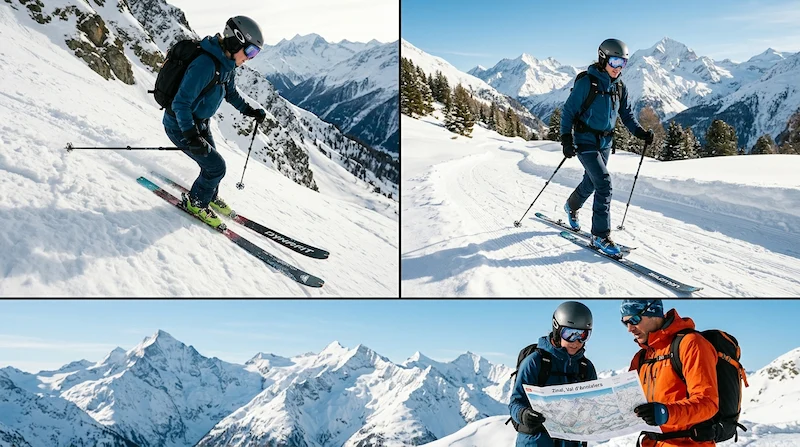
An instructor can break down each component into manageable steps, provide real-time feedback, and ensure you’re building a solid foundation of good habits. Trying to figure it all out on your own can be frustrating and can lead to the development of inefficient techniques that are difficult to unlearn later. A successful first day is one where you end up tired but inspired, with a clear understanding of the core movements and a desire to go out again.
We typically start in a gentle, open area to focus purely on the mechanics. The initial feeling of walking on skis is unique, and it takes time to develop a smooth, gliding motion. We’ll work on pacing, finding a sustainable rhythm that you can maintain without getting exhausted. We’ll practice using the heel risers on your bindings, which are small bars that can be flipped up to reduce calf strain on steeper slopes.
Every part of the day is a learning opportunity, from planning the route on a map to making decisions about where to stop for a break. It’s an active, engaging process that is as much about learning to think like a mountaineer as it is about the physical act of climbing.
Mastering the kick turn and efficient movement
As the terrain gets steeper, you’ll encounter the need to make sharp turns to continue your ascent. This is accomplished with a maneuver called the kick turn. It’s a fundamental skill that allows you to change direction 180 degrees on a steep slope without losing your balance or sliding backward.
The move involves balancing on one ski while lifting the other, pivoting it 180 degrees, and placing it down facing the new direction, followed by bringing the second ski around. It can feel awkward and precarious at first, but with practice, it becomes a fluid and stable movement. We break it down into a sequence of small, deliberate steps, allowing you to build muscle memory in a safe setting.
Beyond the kick turn, overall efficiency is key. The goal is to move uphill with the least amount of wasted energy. This means gliding the skis forward rather than lifting them with each step, a technique often called “shuffling.” It involves using your poles for rhythm and balance, maintaining an upright posture, and breathing steadily.
Small inefficiencies, when repeated thousands of times over the course of a day, add up to significant energy loss. An instructor can identify these issues—like improper pole length, poor posture, or an inefficient stride—and provide corrections that make an immediate difference in your endurance and comfort. This focus on technique is what separates a tiring slog from an enjoyable climb.
| Technique focus | Common beginner mistake | Expert correction and rationale |
|---|---|---|
| Uphill Glide (Skinning) | Lifting the ski with each step like walking. | Slide the ski forward, keeping it on the snow. This conserves significant energy by minimizing vertical movement and maximizing glide. |
| Pacing | Starting too fast and burning out quickly. | Find a “conversational pace” you can maintain all day. Slow and steady is far more efficient than stop-and-start bursts of effort. |
| Kick Turn | Leaning into the hill, causing loss of balance. | Maintain an upright, athletic stance over your downhill ski. This keeps your center of gravity stable and makes the pivot much easier. |
| Layering | Overdressing and sweating heavily on the ascent. | Start “cold.” You will warm up within 10 minutes. Manage layers proactively to avoid sweating, as damp clothes lead to rapid chilling at stops. |
Understanding snow and basic avalanche awareness
While a full avalanche course is necessary for independent travel, your first guided tour is an excellent introduction to the concepts of snow safety. This is a core part of our introductory program. We believe that awareness should be built from day one. This starts with learning how to access and interpret the local avalanche bulletin.
This forecast, produced by regional experts, provides critical information about the current snowpack stability, problem types, and the terrain where hazards are most likely to exist. We teach you how to read this report and, more importantly, how to apply its information to the day’s tour plan. This is the first and most important step in risk management.
On the snow, we’ll introduce you to the concept of terrain management. This involves choosing routes that minimize your exposure to avalanche risk. We’ll point out classic signs of avalanche terrain, such as slope angle (most avalanches occur on slopes between 30 and 45 degrees), cornices, and terrain traps like gullies or cliffs.
You’ll learn how to use a tool called an inclinometer to measure slope angles and how to identify safer route options, such as sticking to ridges or lower-angle terrain. We’ll also dig a small snow pit to look at the different layers in the snowpack, providing a tangible example of how the snowpack is structured. This practical, hands-on approach makes the abstract concepts of snow science real and understandable, forming the building blocks for future learning and safe decision-making.
Choosing the right guided experience
Embarking on your first backcountry adventure with a professional guide or instructor is the single best decision you can make. It accelerates your learning curve, maximizes your safety, and ensures your initial experiences are positive and confidence-building. A good guide does more than just lead you up and down a mountain; they are a coach, a mentor, and a safety manager.
They tailor the day to your specific skill level, fitness, and goals. They know the local terrain intimately, including the hidden gems and the areas to avoid. This local knowledge is invaluable, allowing you to ski the best possible snow in the safest possible manner. The investment in professional instruction pays dividends for your entire ski touring career.
When selecting a service, it’s important to find one that aligns with your learning style and objectives. Look for organizations with certified, experienced guides who have a passion for teaching. A high-end, personalized approach means the focus is entirely on you. Small group sizes or private instruction allow for constant interaction, personalized feedback, and the flexibility to adjust the plan on the fly. This is particularly important when learning a complex new sport. A one-size-fits-all approach rarely works.
You want an experience that feels less like a standard lesson and more like a high-performance consultation, where every element of the day is designed to help you progress and succeed. This is the philosophy that underpins our programs, ensuring that your introduction to the backcountry is as exceptional as the mountains themselves.
What to expect from a beginner-focused tour
A well-structured ski touring for beginners Zinal experience should be comprehensive. It begins before you even hit the snow, with a thorough gear check and a discussion about the day’s plan, including the route, the expected weather, and the avalanche conditions. The on-snow portion will focus heavily on skill development.
Expect to spend a significant amount of time practicing skinning, kick turns, and transitions in a controlled environment before heading for a larger objective. The pace will be relaxed and educational, with plenty of stops to discuss technique, navigation, and snowpack observations.
The objective for the day will be modest. A typical first tour might involve 1-3 hours of climbing, gaining a few hundred meters of elevation. The goal is quality over quantity. The descent is your reward, but it’s also a learning opportunity. Your instructor will provide tips on skiing variable, untracked snow, which can be very different from groomed resort runs.
The day concludes with a debrief, discussing what went well and identifying areas for future practice. You should leave feeling empowered with a new set of skills, a better understanding of the mountain environment, and a clear path for what to learn next. This foundational day sets the stage for all your future adventures.
Why private instruction accelerates your learning
While group lessons can be effective, private instruction offers an unparalleled level of personalization and efficiency. In a one-on-one or small private group setting, the entire day revolves around your specific needs. If you master a skill quickly, you can move on without waiting for others. If you’re struggling with a particular technique, like the kick turn, your instructor can dedicate as much time as necessary to help you perfect it, using different coaching cues and exercises until it clicks. This tailored approach is incredibly effective at building both competence and confidence.
Furthermore, private instruction allows for a deeper dive into the topics that interest you most. Perhaps you’re keen on navigation, or maybe you want to understand more about snow science. Your instructor can adapt the curriculum to focus on your priorities. The rapport you build with a private guide also fosters a more comfortable learning environment, where you feel free to ask questions and make mistakes without pressure.
For families or small groups of friends, it creates a shared experience that is both fun and educational. The efficiency of this focused learning means you can often progress in a single day as much as you might in several group sessions. This is the essence of the service provided by Bespoke Snowsport, where we craft each experience to the individual.
- Personalized feedback: Constant, real-time adjustments to your technique.
- Flexible itinerary: The day is adapted to your energy levels, skills, and the prevailing conditions.
- Targeted skill development: Focus on your specific weaknesses to turn them into strengths.
- Enhanced safety: A lower guide-to-client ratio allows for closer supervision and risk management.
Your journey into the backcountry is a significant and rewarding step in your evolution as a skier. It opens up a lifetime of adventure, challenge, and discovery. Starting with a solid foundation of skills and a deep respect for the mountain environment is the key to a long and safe career in the sport.
The terrain around Zinal provides the perfect canvas, and our expert team provides the knowledge and guidance to help you paint your first masterpiece. We are dedicated to transforming your skiing into a high-performance practice, pushing you beyond your current limits in one of the world’s most spectacular alpine settings.
Are you ready to earn your turns and discover the freedom of the backcountry? Our team of certified professionals is here to guide you every step of the way, from your first kick turn to your first powder descent.
Let us craft a personalized instructional experience that meets your unique goals and unlocks your potential in the mountains. Request any of our ski services, whether it be a private or group lesson, and begin your ski touring journey with us today.